
India Football U15 Trials 2026 FIFA World Cup : What Pune Footballers Should Know

India’s U15 men’s national-team program is identifying young footballers for the FIFA U15 World Cup & Festival 2026. For Pune players, reaching the India youth setup is not simply about attending one open trial. The pathway usually involves structured academy training, regular competitive matches, district and Maharashtra-level football, AIFF youth competitions and opportunities to be identified through scouting program. India U15 Football Camp Underway in Bengaluru The India U15 men’s national-team program is currently assessing promising young footballers ahead of the FIFA U15 World Cup & Festival 2026. Players identified through scouting are being assessed in batches, allowing national-team coaches to evaluate technical ability, tactical understanding, physical development, attitude and long-term potential. For young footballers in Pune, this is important because national-team selection begins much earlier than many players and parents realize. What Is the FIFA U15 World Cup & Festival 2026? The FIFA U15 World Cup & Festival represents an important new international opportunity for young footballers. It gives players an opportunity to experience international opposition and understand the technical, tactical, physical and mental standards required at a higher level. For India, this can also help create a stronger development pathway toward the U17 and later national teams. Indian youth football is entering an exciting new phase. The India U15 Men’s National Team camp is currently underway in Bengaluru, where head coach Bibiano Fernandes and his coaching staff are assessing some of the country’s most promising young footballers ahead of the inaugural FIFA U15 World Cup & Festival 2026. For young footballers in Pune, PCMC, Ravet, Punawale and across Maharashtra, this development is especially important. It shows that serious football opportunities are beginning much earlier—and that performances at grassroots, academy, district, state and national youth competitions can potentially contribute to a player being noticed. India U15 Camp Underway in Bengaluru According to the All India Football Federation (AIFF), the India U15 camp began at the Centre for Sports Excellence in Bengaluru on August 16, 2026. Rather than bringing all identified footballers together at once, players are being invited in different batches for assessment. The scouting and trial phase is expected to continue through the end of August, after which a shortlisted group will move into the next stage of preparation. The ultimate target is a very small squad. Only 14 players are expected to make India’s final squad for the FIFA U15 World Cup & Festival in Azerbaijan. That highlights just how competitive youth football at national-team level has become. FIFA U15 World Cup & Festival 2026 The inaugural FIFA U15 World Cup & Festival 2026 will be held in Azerbaijan from October 22 to October 31, 2026. FIFA has confirmed that the first edition will be open to boys’ teams from FIFA member associations. The competition is part of FIFA’s broader effort to provide international football exposure to players at a younger age. For India, it presents an opportunity for young players to experience the standards of international football before progressing towards the U17 level. Bibiano Fernandes Takes Charge of India U15 AIFF has appointed experienced youth coach Bibiano Fernandes to lead the India U15 men’s team. Fernandes already has an impressive record in Indian youth football. Under his leadership across different age groups, India have qualified for the AFC U17 Asian Cup on multiple occasions, while he has also guided Indian youth teams to several SAFF age-group titles. His approach to selecting young footballers goes beyond technical ability alone. Fernandes has stressed the importance of qualities such as hunger, desire and a never-give-up attitude, while also looking for players who have the potential to eventually progress towards India’s U17 setup. For young Pune footballers, that is an important message. Being talented with the ball is only one part of becoming an elite player. What Are India U15 Coaches Looking For? At this level, coaches are evaluating the complete footballer. Young players hoping to progress through competitive football should therefore work on: The national team’s approach makes it clear that scouting is about identifying long-term potential, not simply selecting the most physically developed child at a particular moment. Can a Pune Player Directly Register for These India U15 Trials? Parents and players should understand an important point. The current national camp should not be treated as a normal open trial where anyone can simply arrive and register. AIFF says the formation of the U15 group follows an extensive nationwide talent-identification process, with scouting for this age group having been underway for nearly two years. Selected players are being invited in batches for assessment. Therefore, the bigger question for a young Pune player should be: How do I get into competitions and environments where my football can be seen? What Are India U15 Coaches Looking For? Young players hoping to progress toward national-level football need much more than good dribbling or shooting ability. Coaches typically assess: At youth level, coaches are often evaluating future potential rather than only current physical strength. Can Anyone Register Directly for India U15 Trials? Parents should understand that national-team camps are not always open trials where any player can simply arrive and participate. Players are generally identified through scouting networks, competitive football, academies, state competitions and recognised youth tournaments. Therefore, the key question should not only be: “Where is the next India trial?” A better question is: “Where should my child play so that selectors can see him regularly?” Football Pathway for Pune Players There is no single guaranteed pathway, but a young Pune footballer’s journey may broadly look like: Grassroots Football → Structured Academy Training → Competitive Matches → District-Level Football → Maharashtra Opportunities → AIFF Youth Competitions → National Scouting → India Youth Camps → India U15/U17/U20 Players should therefore focus on progressing one level at a time. Why Competitive Matches Are Important Training helps players develop skills. Competitive matches determine whether those skills can be used under pressure. Players need experience making decisions when: Regular competitive football is therefore one of the most important parts of player development. What Pune
AIFF Introduces New 8v8 Format for Sub Junior Boys & Girls NFC 2026-27
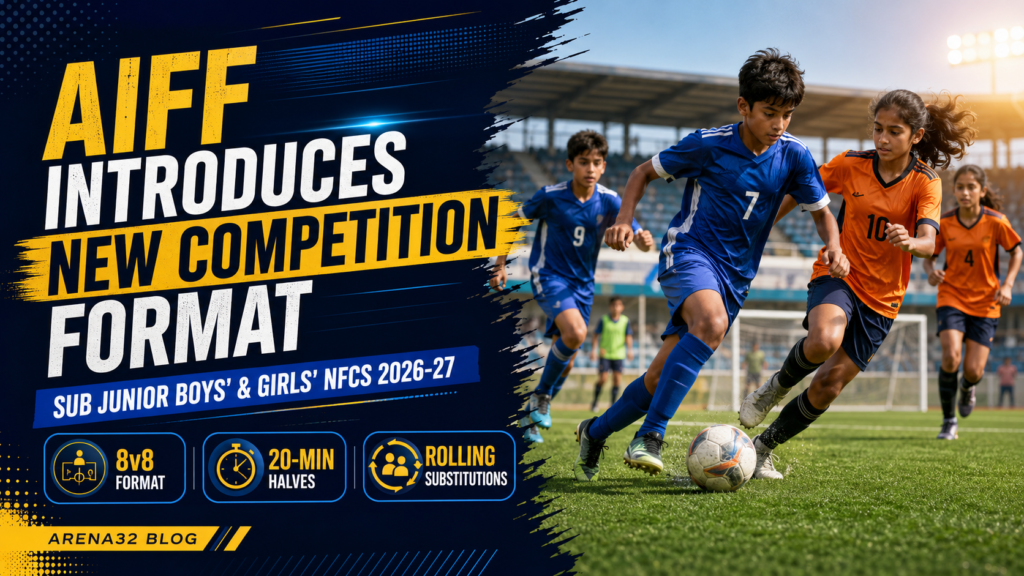
The All India Football Federation (AIFF) has announced an important change to the Sub Junior Boys’ and Girls’ National Football Championships (NFCs) for the 2026-27 season, introducing a new competition format designed to place greater emphasis on player development, technical ability and competitive intensity. Announced on 28 August 2026, the revised format is based on guidelines used for the FIFA U15 World Cup format and represents a significant shift towards a development-oriented model for young footballers in India. For young players, parents, academies and coaches, the changes are particularly interesting because the championship will now emphasise small-sided football, greater involvement in play, faster decision-making and increased opportunities for players to participate in matches. What Has AIFF Changed for the 2026-27 Sub Junior NFC? The biggest change is the introduction of an 8v8 competition format. Instead of simply focusing on the final result, the revised structure is intended to provide young players with an environment where they are more frequently involved with the ball and required to make decisions under pressure. According to AIFF, the objective is to align India’s existing grassroots pathway more closely with global youth-development standards while improving player growth, technical proficiency and intensity of competition. New AIFF Sub Junior NFC 2026-27 Format at a Glance Competition Rule New Format Playing format 8 vs 8 Match duration 2 halves of 20 minutes Half-time 5 minutes Pitch size 68 metres × 50 metres Goal size 7.32 metres × 2.44 metres Offside line 23 metres Substitutions Unlimited rolling substitutions Player registration in CMS Up to 50 players Final tournament squad Minimum 12, maximum 16 players Final squad deadline At least 5 days before first group match These specifications have been officially announced by AIFF for the upcoming Sub Junior Boys’ and Girls’ NFCs. Why 8v8 Football Could Be Important for Young Indian Players The switch to 8v8 football may ultimately be more important than simply reducing the number of players on the field. Small-sided football naturally changes how frequently players become involved in a match. With fewer players occupying the pitch, youngsters generally have fewer opportunities to remain disconnected from play. They need to constantly scan, move, receive the ball, defend and transition between different phases of the game. This can make the format especially valuable during a player’s developmental years. 1. More Involvement With the Ball In a smaller-sided game, players can potentially receive the ball more frequently than in a traditional full-sided match. That gives young footballers more opportunities to practise skills such as: A player cannot develop technical confidence simply by standing on a football field. Development comes from repeatedly experiencing real football situations. An 8v8 structure can help create more of those situations. 2. Faster Decision-Making Modern football requires players to think before receiving the ball. Where are the opponents? Where are the teammates? Is there space behind the defender? Should the player pass, dribble, shoot or recycle possession? Small-sided games typically force these decisions to happen more frequently. Youngsters therefore have the opportunity to improve not only their technique but also their football intelligence. This is particularly important as players progress towards higher levels of competitive football. 40-Minute Matches Could Increase Match Intensity Matches under the new format will consist of: First half – 20 minutesHalf-time – 5 minutesSecond half – 20 minutes That means the scheduled playing time will be 40 minutes. A shorter match combined with fewer players can encourage a relatively high-intensity style of football. Instead of managing energy across a much longer match, players may be expected to repeatedly participate in attacking and defensive situations. This could create more opportunities to develop: Quick transitions: Players must react immediately when their team gains or loses possession. High concentration: One mistake can quickly create a scoring opportunity. Repeated involvement: With eight players per side, each individual has greater responsibility. Attacking confidence: Players may find themselves in more 1v1 and combination situations. AIFF Introduces a 68m × 50m Pitch Another important component of the new competition format is the prescribed playing area. AIFF has specified a pitch measuring: 68 metres long × 50 metres wide The matches will use a standard goal measuring 7.32m × 2.44m. The combination of an 8v8 structure and this playing area is particularly interesting. Young players have space to play football while simultaneously having fewer teammates available as passing options. That can place greater responsibility on each player to understand: In other words, the system has the potential to develop both individual ability and tactical awareness. A 23-Metre Offside Line Will Be Used AIFF has also announced that an offside line will be marked at 23 metres. This is an interesting development feature. Rather than forcing younger footballers to operate under conventional offside conditions across the entire pitch, the designated line creates a defined attacking area where offside becomes relevant. Players must therefore begin learning important concepts such as: Timing attacking runs A forward needs to recognise when to accelerate beyond a defender. Defensive line management Defenders must communicate and understand when to step forward or drop back. Passing timing Midfielders need to release the ball at the right moment. Spatial awareness Attackers learn to recognise the relationship between themselves, defenders, teammates and available space. These tactical concepts become increasingly important as youngsters move towards older youth categories and eventually senior football. Unlimited Rolling Substitutions Are Another Major Change One of the most development-friendly features of the new rules is unlimited rolling substitutions. AIFF will allow substituted players to return to the match multiple times. Outfield substitutions may be made on the fly through the halfway line. Goalkeeper substitutions, however, have to take place during a stoppage. For youth football, this could be significant. Traditional substitution rules can sometimes mean that some squad members receive considerably fewer competitive minutes. Rolling substitutions give coaches more flexibility to manage: A player who leaves the pitch is not necessarily finished for the match. The coach can bring the youngster back later. More Opportunities for Coaches to Develop Players During Matches The
What is Football ? The Past, Present and Future of the World’s Game

Football is more than a sport. It is a language understood by millions of people across countries, cultures and generations. A child playing barefoot on a street, a student playing for school, a professional representing a club, and a national team player standing for the anthem are all connected by one simple game — football. In simple words, football is a team sport played between two teams where players use their feet, body movement, passing, teamwork and strategy to score goals by putting the ball into the opponent’s net. The team that scores more goals wins the match. In most countries, football means association football, also called soccer in some countries. According to the official Laws of the Game, a match is played by two teams with a maximum of eleven players each, and one player in each team must be the goalkeeper. A standard match is played in two halves of 45 minutes, with a half-time interval not exceeding 15 minutes. But football is not only about rules. It is about passion, discipline, skill, fitness, teamwork, emotion and identity. It is the sport where one goal can change a career, one match can unite a country, and one player can inspire an entire generation. The Basic Idea of Football Football looks simple from outside. There is one ball, two goals and two teams trying to score. But once you understand the game deeply, football becomes a combination of skill, intelligence and teamwork. A football player must know how to control the ball, pass accurately, move into space, defend properly, shoot with power and precision, and make quick decisions under pressure. A good team must understand formation, pressing, counter-attack, possession, communication and match tempo. The beauty of football is that it can be played almost anywhere. You do not always need expensive equipment. A ball, a small space and a few players are enough to start. This is one reason football became the most popular sport in the world. The Past: How Football Started The history of football is very old. Many ancient civilizations played ball games using the feet, body and teamwork. Different forms of kicking games existed in many parts of the world, but modern football developed mainly in England during the 19th century. Before football had fixed rules, different schools and clubs followed different styles. Some allowed handling the ball. Some allowed rough physical contact. Some had different goal rules. Because of this confusion, there was a need to standardize the game. A major step came in 1863 when the Football Association in England was formed. The University of Cambridge notes that the Football Association adopted many ideas from earlier Cambridge rules and helped shape the modern game. This was the birth of organized modern football. Once the rules became clearer, football started spreading quickly through schools, clubs, workers, soldiers, sailors and communities. Football Becomes a Global Sport After the rules became standardized, football spread across Europe, South America, Asia, Africa and the rest of the world. Countries created their own football associations, clubs were formed, leagues started, and international matches became more common. In 1904, FIFA — Fédération Internationale de Football Association — was formed as the global governing body of football. FIFA now works with 211 member associations and oversees the development of football from grassroots to elite international competitions. The FIFA World Cup, first played in 1930, became the biggest international football tournament. Over time, other major competitions also grew, including continental tournaments like the UEFA European Championship, Copa América, AFC Asian Cup, Africa Cup of Nations and many more. Club football also became massive. Leagues such as the English Premier League, La Liga, Serie A, Bundesliga and others became global brands. Footballers became international icons, and clubs gained fans in countries far away from their home cities. Why Football Became So Popular Football became popular because it is simple to start but difficult to master. Anyone can kick a ball, but becoming a great player needs years of training. Football also became popular because it connects emotionally with people. A club is not just a club for many fans. It represents a city, community, family tradition and personal identity. A national team is not just eleven players. It represents the pride of an entire country. Football creates unforgettable emotions — joy, heartbreak, hope, anger, celebration and belief. This emotional power is one of the biggest reasons people love the game. Another reason is accessibility. Football does not require very expensive equipment at the basic level. In many countries, children start playing with a simple ball in streets, grounds, schools, beaches and open spaces. The Present: Football Today Today, football is a global industry, a professional career, a fitness activity, a community sport and a powerful entertainment platform. Estimates suggest there are more than 240 million registered players worldwide, with fan participation reaching into the billions. Modern football is faster, more tactical and more scientific than ever before. Players are not trained only to kick and run. They are trained as complete athletes. They follow fitness programs, diet plans, recovery routines, video analysis, sports psychology and data-based performance reviews. In the past, football depended heavily on natural talent. Today, talent is still important, but professional football also demands discipline, strength, stamina, tactical awareness, mental toughness and consistent performance. Modern Football Rules and Structure A standard football match has two teams, and each team has up to eleven players on the field. If a team has fewer than seven players, the match cannot start or continue under the Laws of the Game. A standard match lasts 90 minutes, divided into two 45-minute halves. The referee can add additional time for delays such as substitutions, injuries, disciplinary sanctions, VAR checks, goal celebrations and other stoppages. Modern football also includes substitutes, yellow cards, red cards, fouls, penalties, corners, throw-ins, offside rules and goalkeeper rules. At professional level, technology such as VAR and goal-line technology may be used depending on competition rules. The Role of Technology in
Top 15 Benefits of Playing Football for Kids in PCMC

How Our AIFF Accredited Football Academy in PCMC Helps Children Grow with Confidence, Fitness & Discipline In today’s world, many parents are worried about their child’s screen time, lack of outdoor activity, low confidence, poor fitness, and reduced social interaction. Football is one of the best sports to solve these problems naturally because it keeps children active, disciplined, confident, and mentally strong. For parents looking for a professional football academy in PCMC, Punawale, Ravet, Wakad, Tathawade, Nigdi, Akurdi or nearby areas, We as Football Academy provides a structured training environment where children learn much more than just kicking a ball. At Our AIFF Accredited Football Academy in Punawale Ravet, kids are trained through proper football drills, fitness sessions, match practice, teamwork activities, and coach-led development programs. Our aim is not only to make children better football players, but also to help them grow as confident, healthy, disciplined and responsible individuals. Why Football Is One of the Best Sports for Kids Football is a complete body-and-mind sport. It improves running, balance, stamina, decision-making, coordination, teamwork and focus. Unlike many individual activities, football teaches children how to work with others, handle pressure, follow instructions and stay active. Whether your child wants to play football for fitness, fun, confidence, school-level sports, tournaments or a future career path, joining a professional football academy gives them the right foundation. Top 15 Benefits of Playing Football for Kids 1. Improves Physical Fitness Football is one of the best sports for improving overall fitness in children. During a football session, kids run, sprint, turn, jump, pass, shoot and defend. These movements improve their strength, stamina, flexibility and body control. Children who regularly play football become more active and energetic. It also helps them develop a stronger body, better posture and improved endurance. How We as Football Academy Helps At Our Football Academy, every training session includes warm-ups, football drills, agility work and match-based activities. Children are encouraged to move actively while learning football in a fun and structured way. 2. Reduces Mobile & Screen Addiction Many parents today struggle with mobile addiction, gaming, reels and excessive screen time. Football gives children a healthy outdoor alternative. When kids start enjoying football, they naturally spend more time running, playing and making friends instead of sitting with phones or screens. How We as Football Academy Helps Our academy creates an exciting sports environment where children look forward to coming for training. The energy of the turf, floodlights, teammates and coaches makes football more engaging than mobile games. 3. Builds Discipline Football teaches children the importance of discipline. They learn to arrive on time, follow coach instructions, respect teammates, complete drills properly and maintain consistency. Discipline learned on the football ground often reflects in school, studies and daily habits. How We as Football Academy Helps We follows structured training sessions where children are guided step-by-step. From warm-up to skill drills and match practice, every session teaches children how to stay focused and follow a proper routine. 4. Improves Confidence Many children are shy, hesitant or afraid of making mistakes. Football helps them become more confident because they learn by doing. When a child completes a good pass, scores a goal, makes a save or improves in training, their confidence grows. How We as Football Academy Helps Our coaches encourage every child, whether beginner or advanced. We focus on positive improvement instead of pressure. Children are motivated to try, learn, fail, improve and become better with every session. 5. Teaches Teamwork Football is not a solo game. A player cannot win alone. Children learn how to pass, communicate, support teammates and work together toward one goal. This teamwork habit is extremely useful in school, future careers and personal life. How We as Football Academy Helps At here, kids regularly participate in group drills, team games and match situations. They learn when to pass, when to support, when to defend and how to trust their teammates. 6. Improves Focus & Concentration Football requires quick thinking. A child must watch the ball, understand player movement, listen to the coach, make quick decisions and react fast. This improves concentration and mental alertness. How We as Football Academy Helps Our training includes ball control drills, passing drills, reaction drills and small-sided games. These activities improve focus while keeping the child fully involved in the game. 7. Develops Social Skills Football helps children meet new friends, communicate better and become more socially active. Kids learn how to talk, share, celebrate and handle disagreements in a healthy way. For shy children, football can be a great confidence-building activity. How We as Football Academy Helps We provides a friendly academy environment where kids from different schools and nearby areas train together. This helps children make new friends and become more comfortable in group settings. 8. Builds Mental Strength In football, children face wins, losses, mistakes and pressure. They learn that losing is not failure, and improvement comes through practice. This develops emotional strength and a positive mindset. How We as Football Academy Helps Our coaches teach children to accept mistakes, learn from them and come back stronger. We focus on effort, attitude and improvement, not just the final score. 9. Improves Speed, Agility & Balance Football requires quick turns, sudden sprints, body balance and fast footwork. These movements improve agility and coordination in children. Even children who are not naturally athletic can improve a lot with regular football practice. How We as Football Academy Helps Our football training includes cone drills, ladder drills, ball mastery, speed work and movement-based exercises. These drills help children move better and become more confident on the field. 10. Encourages a Healthy Lifestyle Children who play football regularly become more aware of fitness, food, sleep and routine. They start understanding that performance depends on daily habits. This creates a strong foundation for a healthy lifestyle. How We as Football Academy Helps At our football academy, children are guided to warm up properly, stay hydrated, respect their body and train consistently. We help them