
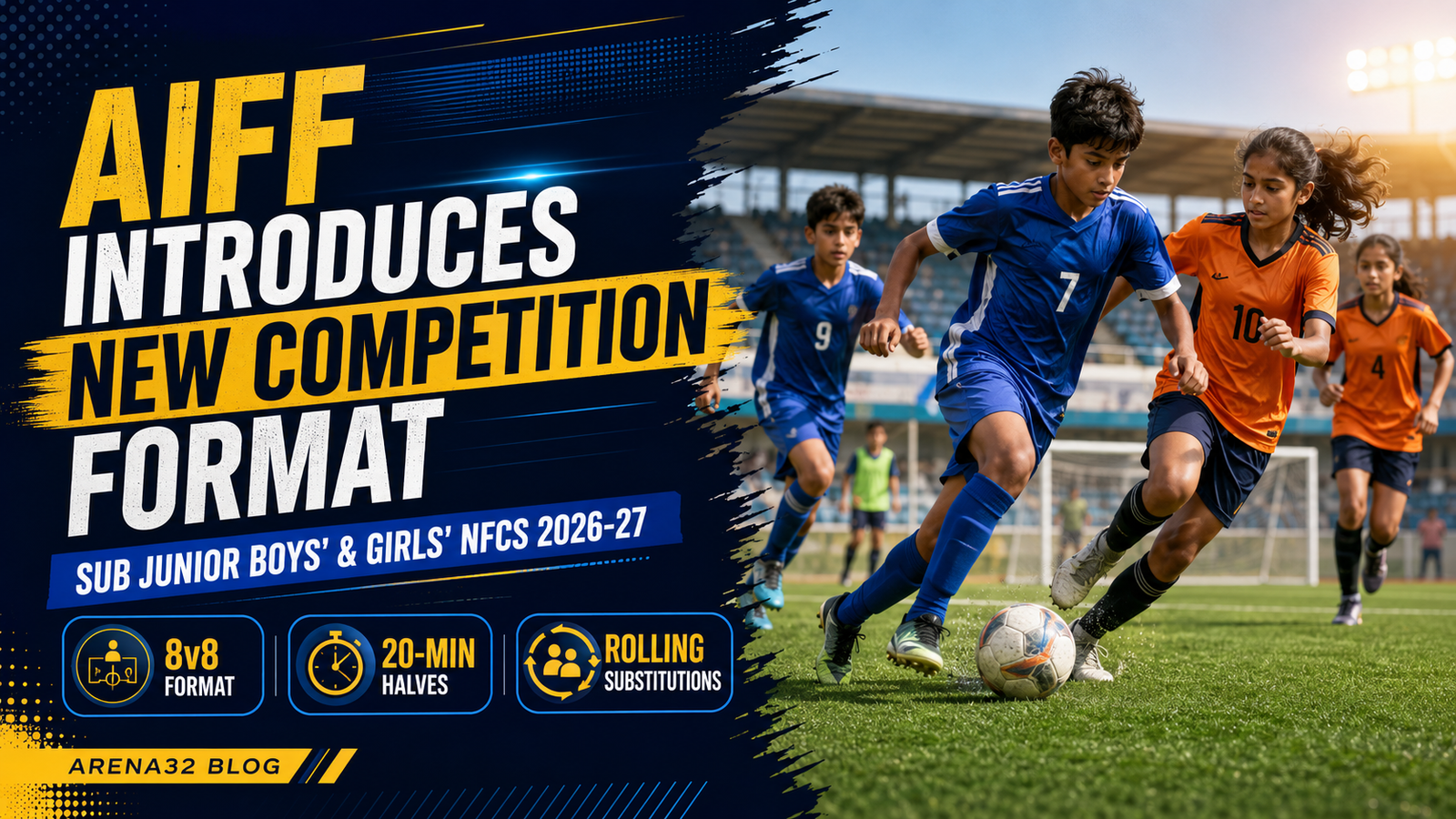
The All India Football Federation (AIFF) has announced an important change to the Sub Junior Boys’ and Girls’ National Football Championships (NFCs) for the 2026-27 season, introducing a new competition format designed to place greater emphasis on player development, technical ability and competitive intensity.
Announced on 28 August 2026, the revised format is based on guidelines used for the FIFA U15 World Cup format and represents a significant shift towards a development-oriented model for young footballers in India.
For young players, parents, academies and coaches, the changes are particularly interesting because the championship will now emphasise small-sided football, greater involvement in play, faster decision-making and increased opportunities for players to participate in matches.
What Has AIFF Changed for the 2026-27 Sub Junior NFC?
The biggest change is the introduction of an 8v8 competition format.
Instead of simply focusing on the final result, the revised structure is intended to provide young players with an environment where they are more frequently involved with the ball and required to make decisions under pressure.
According to AIFF, the objective is to align India’s existing grassroots pathway more closely with global youth-development standards while improving player growth, technical proficiency and intensity of competition.
New AIFF Sub Junior NFC 2026-27 Format at a Glance
| Competition Rule | New Format |
|---|---|
| Playing format | 8 vs 8 |
| Match duration | 2 halves of 20 minutes |
| Half-time | 5 minutes |
| Pitch size | 68 metres × 50 metres |
| Goal size | 7.32 metres × 2.44 metres |
| Offside line | 23 metres |
| Substitutions | Unlimited rolling substitutions |
| Player registration in CMS | Up to 50 players |
| Final tournament squad | Minimum 12, maximum 16 players |
| Final squad deadline | At least 5 days before first group match |
These specifications have been officially announced by AIFF for the upcoming Sub Junior Boys’ and Girls’ NFCs.
Why 8v8 Football Could Be Important for Young Indian Players
The switch to 8v8 football may ultimately be more important than simply reducing the number of players on the field.
Small-sided football naturally changes how frequently players become involved in a match.
With fewer players occupying the pitch, youngsters generally have fewer opportunities to remain disconnected from play. They need to constantly scan, move, receive the ball, defend and transition between different phases of the game.
This can make the format especially valuable during a player’s developmental years.
1. More Involvement With the Ball
In a smaller-sided game, players can potentially receive the ball more frequently than in a traditional full-sided match.
That gives young footballers more opportunities to practise skills such as:
- first touch;
- short passing;
- receiving under pressure;
- dribbling;
- turning;
- combination play;
- finishing;
- tackling;
- positioning.
A player cannot develop technical confidence simply by standing on a football field. Development comes from repeatedly experiencing real football situations.
An 8v8 structure can help create more of those situations.
2. Faster Decision-Making
Modern football requires players to think before receiving the ball.
Where are the opponents?
Where are the teammates?
Is there space behind the defender?
Should the player pass, dribble, shoot or recycle possession?
Small-sided games typically force these decisions to happen more frequently.
Youngsters therefore have the opportunity to improve not only their technique but also their football intelligence.
This is particularly important as players progress towards higher levels of competitive football.
40-Minute Matches Could Increase Match Intensity
Matches under the new format will consist of:
First half – 20 minutes
Half-time – 5 minutes
Second half – 20 minutes
That means the scheduled playing time will be 40 minutes.
A shorter match combined with fewer players can encourage a relatively high-intensity style of football.
Instead of managing energy across a much longer match, players may be expected to repeatedly participate in attacking and defensive situations.
This could create more opportunities to develop:
Quick transitions: Players must react immediately when their team gains or loses possession.
High concentration: One mistake can quickly create a scoring opportunity.
Repeated involvement: With eight players per side, each individual has greater responsibility.
Attacking confidence: Players may find themselves in more 1v1 and combination situations.
AIFF Introduces a 68m × 50m Pitch
Another important component of the new competition format is the prescribed playing area.
AIFF has specified a pitch measuring:
68 metres long × 50 metres wide
The matches will use a standard goal measuring 7.32m × 2.44m.
The combination of an 8v8 structure and this playing area is particularly interesting.
Young players have space to play football while simultaneously having fewer teammates available as passing options.
That can place greater responsibility on each player to understand:
- positioning;
- width;
- depth;
- movement without the ball;
- defensive coverage;
- passing angles;
- numerical advantages;
- transition moments.
In other words, the system has the potential to develop both individual ability and tactical awareness.
A 23-Metre Offside Line Will Be Used
AIFF has also announced that an offside line will be marked at 23 metres.
This is an interesting development feature.
Rather than forcing younger footballers to operate under conventional offside conditions across the entire pitch, the designated line creates a defined attacking area where offside becomes relevant.
Players must therefore begin learning important concepts such as:
Timing attacking runs
A forward needs to recognise when to accelerate beyond a defender.
Defensive line management
Defenders must communicate and understand when to step forward or drop back.
Passing timing
Midfielders need to release the ball at the right moment.
Spatial awareness
Attackers learn to recognise the relationship between themselves, defenders, teammates and available space.
These tactical concepts become increasingly important as youngsters move towards older youth categories and eventually senior football.
Unlimited Rolling Substitutions Are Another Major Change
One of the most development-friendly features of the new rules is unlimited rolling substitutions.
AIFF will allow substituted players to return to the match multiple times. Outfield substitutions may be made on the fly through the halfway line. Goalkeeper substitutions, however, have to take place during a stoppage.
For youth football, this could be significant.
Traditional substitution rules can sometimes mean that some squad members receive considerably fewer competitive minutes.
Rolling substitutions give coaches more flexibility to manage:
- playing time;
- fatigue;
- tactical adjustments;
- player rotation;
- match intensity;
- individual development.
A player who leaves the pitch is not necessarily finished for the match.
The coach can bring the youngster back later.
More Opportunities for Coaches to Develop Players During Matches
The format may also change the role of youth coaches.
Rather than viewing every substitution as a permanent tactical decision, coaches can potentially use substitutions as part of the development process.
For example, a coach could temporarily remove a player, explain something the player is struggling to recognise, and potentially reintroduce the player later.
Likewise, players can experience different positions during the same competition.
A youngster might play:
right defender → midfielder → winger
during different periods of a match.
Developing players who understand multiple positions can be valuable because youth football should not always be about specialising a child into one role too early.
Squad Registration: Up to 50 Players in AIFF CMS
Participating teams will be able to register up to 50 players in the AIFF Competition Management System (CMS).
However, teams must then nominate their final competition squad before their group begins.
The final list must contain:
Minimum: 12 players
Maximum: 16 players
The squad must be submitted at least five days before the team’s opening group-stage match.
This gives teams a relatively large preliminary pool while maintaining a compact final squad for the actual tournament.
Competition Scheduling Will Also Change
AIFF has stated that the championship schedule will include consecutive match days followed by a mandatory one-day rest period before the knockout stage begins.
For developing footballers, tournament-style scheduling presents a different challenge from playing one league game every week.
Players must learn about:
- recovery;
- hydration;
- nutrition;
- sleep;
- workload;
- preparation;
- physical conditioning;
- mental recovery between matches.
As players move towards elite competition, understanding recovery becomes almost as important as understanding training itself.
What Does This Mean for Football Academies in India?
The announcement should also be closely studied by football academies.
Although academy training does not have to reproduce the championship format every day, coaches can incorporate many of the developmental principles behind it.
Training programmes can include more:
4v4 matches
Useful for close control, quick passing and decision-making.
5v5 and 6v6 matches
Useful for transitions, combinations and creating passing angles.
7v7 and 8v8 games
Useful for tactical structure while maintaining high player involvement.
Position-specific scenarios
Rather than spending an entire session playing unrestricted matches, coaches can create situations repeatedly experienced during competitive games.
For example:
3 attackers vs 2 defenders
4 midfielders vs 3 midfielders
2v2 plus goalkeeper
4v4 transition games
These exercises can produce dozens of football decisions during a training session.
Why Small-Sided Football Matters at Grassroots Level
One of the biggest challenges in youth development is ensuring that children actually get enough meaningful interaction with the football.
Imagine two young players playing the same amount of time.
Player A touches the ball 15 times.
Player B touches the ball 50 times.
Over hundreds of training sessions and matches, that difference becomes enormous.
Small-sided football can increase the probability that every child becomes actively involved rather than allowing only the strongest or most physically dominant youngsters to control the game.
It can encourage children to solve football problems themselves.
Technical Development Could Become Even More Important
The new format also sends an important message to parents and young footballers.
Being the tallest, strongest or fastest player at a young age is not enough.
Football increasingly rewards players who can:
- control the ball quickly;
- use both feet;
- scan before receiving;
- make decisions under pressure;
- recognise space;
- play accurate passes;
- defend one-on-one;
- create passing angles;
- transition quickly;
- communicate with teammates.
The revised Sub Junior NFC environment should give players frequent opportunities to demonstrate these qualities.
What Young Footballers Should Focus on Now
Players who aspire to compete at district, state and national levels should use developments such as the new AIFF format as a signal about how youth football is evolving.
Training should not focus only on running, fitness or shooting.
A complete young footballer’s development should include technical, tactical, physical and mental components.
Players should particularly work on:
First touch: The ability to control the ball into useful space.
Scanning: Looking around before receiving possession.
Passing under pressure: Maintaining accuracy when defenders are close.
1v1 ability: Both attacking and defending.
Weak-foot development: Becoming comfortable using both feet.
Movement without the ball: Creating space for yourself and teammates.
Transition speed: Immediately reacting when possession changes.
Communication: Helping teammates recognise danger and opportunities.
What the New Format Means for Parents
Parents sometimes judge youth football primarily through goals, trophies and match results.
But at the Sub Junior level, development should remain the bigger objective.
A child who develops stronger technical ability, decision-making and football intelligence can benefit much more in the long term than a player whose team simply wins youth tournaments.
Parents should therefore consider questions such as:
Does my child receive enough touches during training?
Is the coach teaching decision-making?
Does my child experience different match situations?
Is training appropriate for the child’s age?
Does the player enjoy football?
Is there meaningful competitive exposure?
Are mistakes treated as part of learning?
The new AIFF approach reinforces the importance of creating environments where young footballers can play, experiment, compete and improve.
What This Means for Young Footballers in Pune & PCMC
For young footballers training in Pune, PCMC, Ravet and Punawale, developments at the national level matter even if they are currently playing at academy, school or grassroots level.
The pathway towards higher-level football becomes easier to understand when training methods begin preparing players for the type of football they may encounter at district, state and national competitions.
At Arena32 Turf, small-sided competitive football can play an important role in developing technical confidence, quick decision-making, combination play and match awareness among young players.
The goal for a young footballer should not simply be to play more matches.
It should be to become a better footballer every time they train and compete.
A Positive Direction for Indian Youth Football
The 2026-27 Sub Junior NFC format indicates a broader shift towards making youth football more development-focused.
AIFF itself says that the revised structure is intended to enhance player growth, technical proficiency and competitive intensity, while bringing India’s grassroots pathway closer to international standards.
The real impact will become clearer once players, coaches and state teams begin competing under the new rules.
However, the underlying idea is encouraging:
Give young players more involvement.
Give them more decisions to make.
Give coaches greater flexibility.
Make competitive football part of the development process.
And ultimately, create better-prepared players for the next stages of Indian football.
The Future of Indian Football Starts at the Grassroots
India’s progress in international football cannot begin only with the senior national team.
It has to begin years earlier—with children receiving quality coaching, meaningful match exposure and development-focused competition.
Changes such as the new AIFF Sub Junior Boys’ and Girls’ NFC 2026-27 format therefore deserve attention beyond the teams participating in the championship.
They can influence the way academies train players, the way coaches design sessions and even the way parents understand youth football development.
An 8v8 match may look like a small change.
But if it gives thousands of young footballers more touches, more decisions, more responsibility and more opportunities to learn, its long-term effect could be considerably bigger.
For India’s next generation of footballers, that is what matters most.
Official Source
The competition-format information in this article is based on the official announcement published by the All India Football Federation on 28 August 2026.