
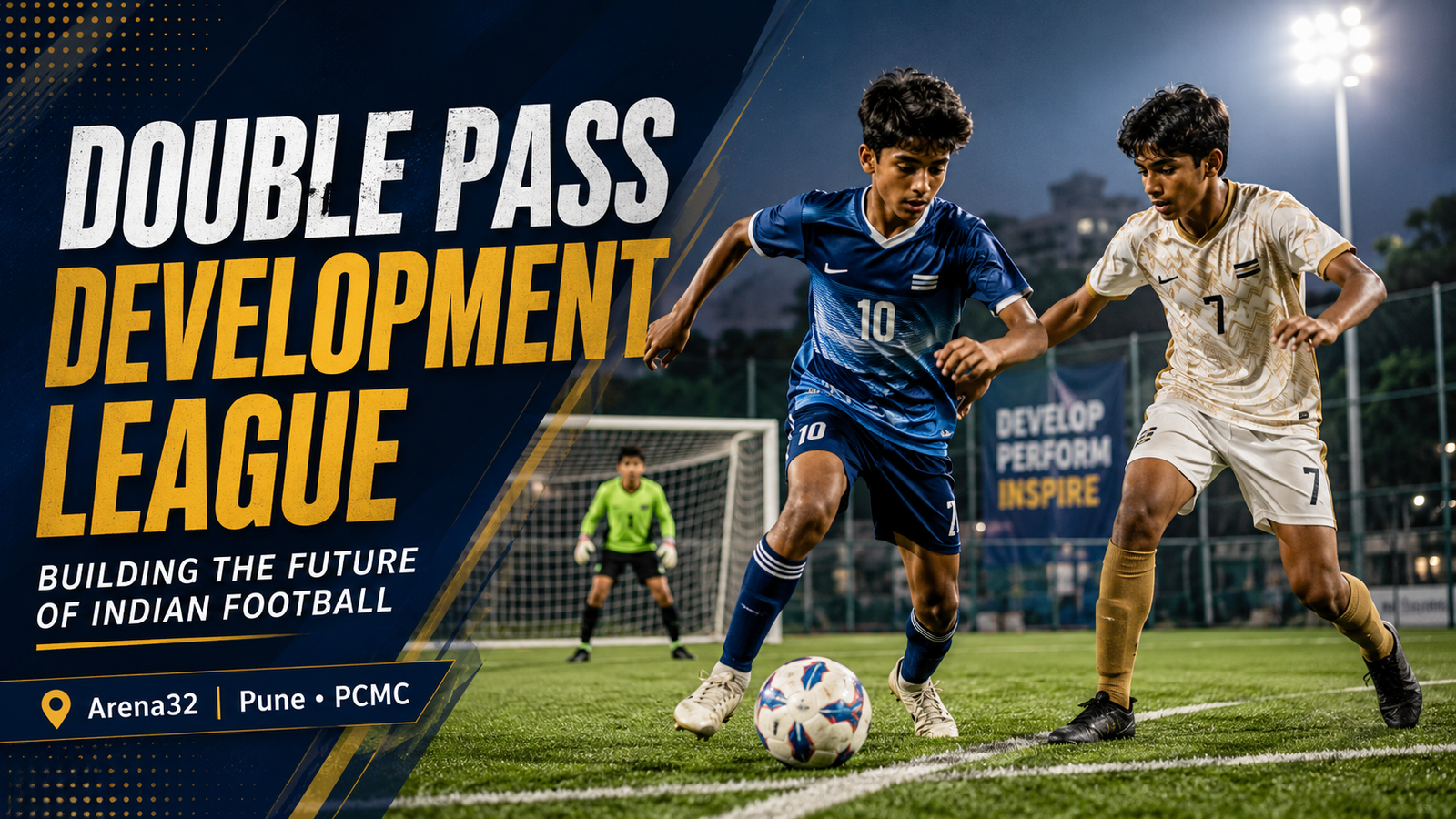
For thousands of young footballers across India, talent is rarely the only challenge.
A child may train three or four times every week, learn passing, dribbling, defending and finishing, and spend hundreds of hours at an academy.
But footballers are not developed through training alone.
They need competitive matches.
They need different opponents.
They need pressure.
They need victories.
They need defeats.
They need opportunities to make decisions when the coach cannot stop the game and explain what to do.
And most importantly, they need those experiences repeatedly over several years.
That is the development gap that the Double Pass Development League — popularly known as DPDL — is attempting to address in Indian youth football.
Double Pass describes DPDL as a structured, competitive youth football ecosystem developed specifically for Indian conditions rather than simply copying a European competition model. The organisation says DPDL began with one city in the 2019/20 season before expanding systematically.
By 2026, it had become something considerably larger.
According to Double Pass’ official August 2026 assessment of the project, DPDL had delivered 10,234 matches, 14,435 player-participations, 1,107 team entries and 6,580 hours of football across six seasons, with a pathway spanning U6 through U19 along with girls’ football.
That makes DPDL an important development story for anyone interested in the future of Indian football.
🎥 WATCH: What Is the Double Pass Development League?
DPDL’s official YouTube channel describes the league as a complete competition pathway for grassroots and youth football.
What Does DPDL Stand For?
DPDL stands for Double Pass Development League.
The project is connected to Double Pass, a Belgium-born football talent-development organisation that has operated since 2004.
Double Pass describes itself as a global football talent-development organisation working with federations, leagues, clubs and governments through auditing, analysis, education, mentoring and implementation. Its methodology has roots in more than two decades of applied research and innovation associated with Vrije Universiteit Brussel.
Its wider portfolio has included work involving organisations and football systems such as FIFA, the English Premier League, the United States Soccer Federation, the Italian Football Federation and the Bundesliga/German football system.
But building football in India requires something different.
India cannot simply import another country’s academy system and expect identical results.
Different cities have different facilities, academy structures, travel requirements, player populations and football cultures.
DPDL therefore developed its Indian ecosystem around a straightforward principle:
Adapt proven talent-development thinking to Indian football realities, test it, improve it and scale it city by city.
Why Was DPDL Created?
Indian grassroots football has never suffered from a shortage of children interested in playing.
One of the bigger challenges is providing those players with enough structured competitive football over an extended period.
Weekend tournaments are exciting.
Knockout competitions are exciting.
Trials can create opportunities.
But player development requires something more consistent.
A young player who trains for months but plays only a handful of meaningful competitive matches has limited opportunities to apply what he or she is learning.
DPDL’s model therefore emphasizes regular competitive games rather than building the entire development pathway around occasional tournaments.
Double Pass says approximately 94% of the 10,234 DPDL matches delivered across its first six seasons were season-long competitive league fixtures.
That distinction matters.
Training teaches a footballer how to perform a skill.
Matches teach a footballer when, where and why to use it.
DPDL in Numbers: Six Seasons of Youth Football
Double Pass published updated verified numbers on August 3, 2026.
| DPDL Development Metric | Official Figure |
|---|---|
| City leagues + national competition | 7 leagues + 1 Super Cup |
| Player-participations | 14,435 |
| Team entries | 1,107 |
| Matches delivered | 10,234 |
| Football played | 6,580 hours |
| Development pathway | U6 to U19 |
| Age groups | 15 |
| Finals | 88 |
| Academies reaching finals | 73 |
| Academies winning titles | 38 |
| Girls’ football | Included |
These numbers explain why DPDL should be viewed as an ecosystem rather than simply another football tournament.
Thousands of individual matches create thousands of learning situations.
A defender learns to handle a faster attacker.
A goalkeeper experiences a penalty under match pressure.
A midfielder learns when possession should be retained rather than forcing a forward pass.
A striker experiences missing an opportunity and having to recover mentally before the next chance.
Coaches learn too.
Every competitive match gives coaches information that training alone cannot provide.
From One City to a Growing Indian Football Network
DPDL started with a city-based development model before expanding into additional football markets.
Its current official Instagram presence lists:
Bengaluru, Mumbai, New Delhi, Chennai, Kolkata, Goa and Thane.
As of August 11, 2026, DPDL’s official Instagram communication also says its Bengaluru 2026/27 season begins on August 15, illustrating how the next competition cycle is already underway.
This city-by-city expansion is important.
Grassroots football works best when competition becomes accessible enough for academies to participate regularly rather than repeatedly travelling across India simply to obtain meaningful games.
The stronger the local competition network becomes, the stronger India’s national player-development pyramid can potentially become.
📱 FOLLOW THE DPDL JOURNEY ON INSTAGRAM
Official DPDL Instagram:
https://www.instagram.com/dpdl_official
DPDL uses its social channels extensively for match action, player achievements, championship moments, registrations and grassroots storytelling. Its official account currently identifies activity across Bengaluru, Mumbai, New Delhi, Chennai, Kolkata, Goa and Thane.
Embed the Instagram profile or one of the current match reels directly into the article so visitors can experience DPDL rather than only read about it.
The Real Value of a Season-Long Youth Football League
One of the strongest characteristics of DPDL is repetition.
A footballer’s development is rarely linear.
One weekend a player may be outstanding.
The following weekend the same player might struggle against a completely different opponent.
That variability is valuable.
It develops football intelligence.
Instead of asking only:
“Did our team win?”
Youth development begins asking:
Did the player improve?
Did the player make better decisions?
Can the player perform against stronger opposition?
Can he or she recover from mistakes?
Can the team apply training concepts under competitive pressure?
This is consistent with the philosophy Double Pass describes for its Indian ecosystem: building standards, systems and sustained competition rather than relying principally on trials or short-term exposure events.
DPDL and the Early Grassroots Years
DPDL’s relationship with structured grassroots football goes back several years.
In November 2020, the All India Football Federation featured Bengaluru’s Double Pass Development Golden Baby League, discussing children aged approximately 6–12 and emphasizing technical development, enjoyment, fair play, parental behaviour and the importance of young players receiving plenty of match opportunities.
Former India international and youth-development coach Naushad Moosa was among those discussing the importance of allowing children to learn rather than placing excessive pressure on them simply to win.
That philosophy remains one of the most important ideas in grassroots football.
At U7, U8 or U9 level, a trophy should never be more important than development.
Winning matters because competition matters.
But learning how to play matters more.
The Pathway: From Grassroots to Competitive Youth Football
The latest Double Pass project review describes DPDL’s pathway as running from U6 through U19 across 15 age groups, together with girls’ football.
This is significant because player-development requirements change dramatically with age.
A six-year-old needs enjoyment, coordination, confidence and frequent interaction with the ball.
A nine-year-old needs technical repetition and decision-making.
An eleven- or thirteen-year-old begins understanding space, positioning, transitions and team principles at a deeper level.
Older youth players require increasing tactical intelligence, physical development, competition and preparation for higher-performance football.
A genuine development ecosystem therefore cannot use the same match environment for every age.
The pitch gets bigger.
Team sizes change.
Tactical complexity increases.
Match demands evolve.
And the player must evolve with them.
DPDL Super Cup: Where the Ecosystem Comes Together
The city leagues create regular competition.
The DPDL Super Cup provides another dimension — bringing strong teams and academies together in a national tournament environment.
The inaugural DPDL Super Cup in 2023 featured 36 teams across U12, U14 and U16 categories at the Padukone-Dravid Centre for Sports Excellence in Bengaluru, with participating organisations including Bengaluru FC, Reliance Foundation Young Champs, Barça Academy, AC Milan Kerala, Alchemy International and Belgaum United Football Academy.
By 2025, the competition had grown substantially.
DPDL’s own post-event reporting said the 2025 Super Cup involved 46 youth teams from 26 academies, more than 750 players and participants representing 10 Indian states, producing more than 5,400 minutes of competitive football.
The 2025 champions were:
U11 — Alchemy IFA
U13 — Belgaum United FA
U15 — Alchemy IFA
U17 — Football 4 Change
The event also brought together players, coaches, parents, partners and figures from the Indian football ecosystem, while selected content reached audiences digitally.
🎥 WATCH DPDL SUPER CUP MATCH ACTION
Recommended video embed here
DPDL Super Cup — Under-17 live match coverage:
DPDL’s official YouTube channel includes live and recorded competition coverage, creating an additional layer of visibility for youth teams and the league.
For young players, seeing their matches professionally presented can also help make grassroots football feel like an important part of the wider football ecosystem.
Small-Sided Football and Player Development
One reason youth competitions use different formats is that children should not simply be placed on an adult football pitch and expected to develop optimally.
Smaller formats can increase player involvement.
There are more touches.
More one-versus-one situations.
More passes.
More decisions.
More defensive actions.
More chances to shoot.
And fewer opportunities for a player to disappear from the game.
The DPDL Super Cup has also demonstrated progression between playing formats. For example, its 2025 event documentation scheduled U11 as 8v8, U13 as 9v9 and U15/U17 as 11v11, reflecting the transition toward full-format football as players grow older.
This distinction is particularly important when choosing tournament venues.
A good youth football venue is not simply “a big turf.”
It must match the technical requirements of the specific age group and competition format.
Why DPDL Matters for Parents
Parents naturally want their child to succeed.
But youth football development should not be measured only through goals, trophies or whether a child is selected first.
A strong competition environment can help children develop confidence, discipline, teamwork, resilience and decision-making while learning to cope with both success and disappointment.
The AIFF’s earlier feature on the Double Pass Development Golden Baby League specifically highlighted constructive parental support, fair play and allowing coaches to teach children without conflicting instructions constantly coming from the sidelines.
For parents, therefore, the value of a competition such as DPDL is not simply:
“My child played another tournament.”
The bigger value is:
“My child is receiving repeated opportunities to learn through competitive football.”
Why DPDL Matters for Football Academies
An academy can conduct excellent training sessions.
But how does the academy know whether its methodology is actually producing better footballers?
Competitive matches provide feedback.
Can players build from the back?
Can they press together?
Can defenders handle transitions?
Can midfielders identify space?
Can attackers make decisions quickly?
Can players remain composed when losing?
Can the team solve problems without the coach controlling every action?
Season-long competition continually exposes strengths and weaknesses.
That information allows coaches to adjust their training programme.
Competition therefore becomes part of the curriculum rather than something separate from development.
Why DPDL Matters for Indian Football
India does not need only more football academies.
India needs stronger connections between:
training → competition → evaluation → improvement → higher competition.
Double Pass’ latest description of DPDL specifically identifies the next stage of the project as moving further from the platform toward a deeper development pathway, including benchmarking and academy assessment.
That is an important distinction.
Football nations are rarely developed through one superstar appearing unexpectedly.
They are built by creating environments in which thousands of players receive better coaching and better competition for many consecutive years.
The larger the quality player pool becomes, the greater the opportunity to discover exceptional talent.
Could Pune Be the Next Major DPDL Football Market?
This is where the story becomes particularly interesting for Maharashtra.
DPDL already operates in Mumbai and Thane, while its wider national expansion now includes cities including Bengaluru, Delhi, Chennai, Kolkata and Goa.
But Pune and Pimpri-Chinchwad represent another potentially interesting football market.
And there is already a hint of the connection.
DPDL recently published social content describing a “Maharashtra Derby” involving Pune and Mumbai within its competition storytelling.
That is exactly the type of rivalry that can help grassroots football grow.
Pune vs Mumbai.
PCMC vs Mumbai.
Academy vs academy.
Weekend after weekend.
Season after season.
Imagine young players from Ravet, Punawale, Wakad, Nigdi, Akurdi, Chinchwad, Hinjawadi and the wider Pune region having regular opportunities to test themselves against strong academies within an organised development league.
The question should not simply be:
“Are there talented footballers in Pune?”
A more useful question is:
“How much better could Pune’s young footballers become if they received even more structured, meaningful competition?”
📱 WATCH: THE PUNE–MUMBAI CONNECTION
Recommended Instagram Reel Embed
DPDL — Maharashtra Derby, Pune vs Mumbai:
https://www.instagram.com/reel/DYuPZSvzYan
This is an excellent social embed to place immediately before the Pune/PCMC section because it connects the national DPDL story directly with Pune.
DPDL Pune / PCMC: An Opportunity Worth Exploring
A Pune or PCMC DPDL ecosystem could potentially bring together established academies, emerging football schools, independent coaches, schools and community football programmes under one structured competition environment.
For DPDL, the opportunity would not only be adding another city name.
It would be building another local competition ecosystem.
That is consistent with Double Pass’ own description of how DPDL scaled: develop the model, validate it and then establish repeatable city-level competitions rather than treating expansion as isolated events.
Pune and PCMC could therefore become an interesting future extension of the Maharashtra football story already developing around Mumbai and Thane.
And if DPDL decides to explore that possibility, Arena32 would be proud to support the conversation.
An Open Invitation to DPDL from Arena32, Pune–PCMC
To the Double Pass Development League team:
Arena32 would love to welcome DPDL to Pune and Pimpri-Chinchwad.
We admire what DPDL is building.
10,000+ matches are not built through marketing.
They are built through organisation.
Through coaches.
Through referees.
Through venues.
Through academy participation.
Through parents giving up weekends.
And most importantly, through thousands of young footballers repeatedly stepping onto a pitch.
That philosophy aligns strongly with what we want football facilities in PCMC to become:
places where young footballers actually develop.
Arena32 is located in the Punawale–Ravet area of Pimpri-Chinchwad and currently supports football formats from 5v5 through 9v9. Its published facilities include professional floodlighting, flexible playing zones, parking, washrooms, café/seating facilities and tournament use.
The venue’s published main play area is approximately 160 ft × 110 ft, making Arena32 principally a small-sided football facility rather than a regulation 11v11 stadium.
And we believe being transparent about that matters.
We are not suggesting that DPDL compromise its competition standards to fit a venue.
We are inviting the DPDL technical and operations team to evaluate Arena32 and determine whether the facility could be useful for suitable age categories and programmes.
Depending on DPDL’s official technical requirements, Arena32 could potentially support grassroots small-sided fixtures, football festivals, academy matchdays, trials, scouting activities, development events, training programmes, promotional events or pilot competition activity in PCMC.
For formats requiring larger regulation pitches, we fully recognise that a different venue would be required.
Development standards should determine the venue — not the other way around.
Why Arena32 Wants to Work with DPDL
The objective is bigger than simply renting a football ground.
Arena32 wants to become part of a stronger youth-football ecosystem in Pune and PCMC.
A successful DPDL matchday could bring together young players, academies, coaches, parents, referees, football fans, sponsors and content creators.
For participating children, it creates memories.
For academies, it creates competition.
For coaches, it creates learning.
For parents, it creates visibility into their child’s development.
For DPDL, it potentially creates another community around the league.
And for Indian football, every well-organised grassroots match adds another small building block to a much larger pathway.
What Arena32 Could Offer for a DPDL Pune/PCMC Pilot
Arena32’s existing public venue information includes football configurations from 5v5, 6v6, 7v7 and 8v8 through 9v9, professional floodlighting, flexible ground configurations and amenities including parking, washrooms, seating/café facilities and tournament support.
Rather than prescribing a competition format to DPDL, Arena32 would prefer DPDL’s technical team to determine exactly what could appropriately be conducted at the venue.
A possible collaboration could start small.
A grassroots festival.
An academy showcase.
A DPDL experience day.
A small-sided match weekend.
A Pune talent-identification or engagement event.
A preseason event.
Or simply a technical venue inspection to understand whether Arena32 has a place within DPDL’s future Pune/PCMC plans.
If the answer is yes, Arena32 would be delighted to work around DPDL’s requirements.
A Message to Pune & PCMC Football Academies
Pune football does not grow because one academy grows.
It grows when the competition around every academy improves.
Strong opponents make strong players.
Strong leagues make strong academies.
Strong academies increase the player pool.
And a larger high-quality player pool creates more opportunities for exceptional footballers to emerge.
Instead of seeing another academy as a competitor for admissions, youth football should also see that academy as something more valuable:
an opponent capable of making your players better.
That is why structured leagues matter.
A Message to Young Football Players
Every young player dreams differently.
Some want to represent their school.
Some want to play academy football.
Some dream about the I-League.
Some dream about the Indian Super League.
Some dream of wearing India’s blue jersey.
And some dream even further.
But every pathway begins with the same basic requirement:
Play football.
Not only training.
Not only drills.
Not only watching football videos.
Play competitive matches.
Make mistakes.
Learn.
Play again.
Face stronger players.
Learn again.
Become stronger.
A development league cannot guarantee that a child becomes a professional footballer.
No responsible football organisation can guarantee that.
What a development league can provide is something much more useful:
a better environment in which a footballer has the opportunity to develop.
DPDL’s Bigger Contribution: Creating Football Habits
Perhaps DPDL’s most important achievement cannot be represented by one trophy.
It is the habit of competition.
A player knows there is another match.
A coach has another opponent to prepare for.
An academy has a season to manage.
Parents have another weekend of football.
Teams develop rivalries.
Players remember opponents.
Results begin to matter.
Development becomes measurable.
Football becomes part of the weekly routine.
That is how sporting cultures are built.
Not once a year.
Every week.
From Grassroots to Pro Boots
DPDL frequently uses the phrase #GrassrootsToProBoots across its official communication.
The phrase captures the ambition behind the project.
Not every grassroots player will become professional.
But every professional player was once a grassroots player.
The responsibility of a football ecosystem is therefore to ensure that the talented child is given enough opportunities to keep progressing.
Better coaching.
Better competition.
Better environments.
Better evaluation.
Better pathways.
Year after year.
Could the Next DPDL Story Be Written in Pune?
DPDL began in one city.
Double Pass now reports seven city leagues plus a national Super Cup.
Expansion has already taken the ecosystem across multiple regions of India.
Pune and PCMC could represent another exciting chapter.
There is football passion here.
There are young players.
There are coaches.
There are academies.
There are parents willing to support their children’s dreams.
And there are venues willing to support structured competition.
Arena32 would be honoured to be one of them.
DPDL — Pune & PCMC Are Ready to Play.
To the Double Pass Development League team:
If DPDL considers a Pune or Pimpri-Chinchwad competition, grassroots programme, small-sided league, festival, academy showcase, trial, activation or development event in the future, we invite your team to visit and evaluate Arena32.
Inspect the ground.
Check the dimensions.
Review the facilities.
Discuss the age categories.
Tell us what would need to change.
Tell us what DPDL expects from a host venue.
And if Arena32 meets the required standards for an appropriate DPDL activity, we would be proud to welcome the DPDL community to PCMC.
Because the future of Indian football will not be created by one organisation, academy or venue alone.
It will be built when organisations committed to player development work together.
Grassroots. Competition. Development. Pathway.
That is the journey.
And Pune deserves to be part of it.
Frequently Asked Questions About DPDL
What is DPDL in football?
DPDL stands for Double Pass Development League, a structured grassroots and youth football competition ecosystem in India connected with the football talent-development organisation Double Pass. Double Pass’ August 2026 project review describes it as a pathway spanning U6 to U19 together with girls’ football.
When did DPDL start in India?
Double Pass says the city-league model began in the 2019/20 season, initially operating in one city before being expanded. DPDL’s LinkedIn company information also lists its founding year as 2019.
How many DPDL matches have been played?
According to Double Pass’ August 3, 2026 project report, DPDL had delivered 10,234 matches across six seasons, with approximately 94% being season-long competitive league fixtures.
What age groups play in DPDL?
The latest Double Pass overview describes a development pathway from U6 through U19 across 15 age groups, plus girls’ football. Exact categories may vary between specific competitions and cities.
Which cities currently have DPDL?
As of August 2026, DPDL’s official Instagram identifies Bengaluru, Mumbai, New Delhi, Chennai, Kolkata, Goa and Thane.
What is the DPDL Super Cup?
The DPDL Super Cup brings youth clubs and academies together for national-level tournament competition. The 2025 edition featured 46 teams, 26 academies, 750+ players and participants from 10 states, according to DPDL’s post-event reporting.
Is DPDL currently in Pune?
DPDL’s current official city listing does not show Pune as a standalone league city as of August 2026. However, DPDL has published Maharashtra football content featuring a Pune vs Mumbai matchup, demonstrating Pune’s connection with its wider competition audience.
Can Arena32 host DPDL matches in Pune?
That decision must ultimately be made by DPDL after assessing the venue against the technical requirements of the relevant age group and competition. Arena32 supports small-sided formats up to 9v9 and has a published main playing area of approximately 160 × 110 ft, so it should not be represented as a regulation 11v11 venue. It could instead be evaluated for appropriate grassroots and small-sided DPDL activities.
Follow Double Pass Development League
Instagram:
https://www.instagram.com/dpdl_official/
YouTube:
https://www.youtube.com/@dpdlofficial
Facebook:
https://www.facebook.com/dpdl.official/
LinkedIn:
https://in.linkedin.com/company/double-pass-development-league
DPDL’s official social platforms regularly publish matchday content, results, player stories, registrations, league updates and competition videos.
About Arena32
Arena32 – Multi Sports Turf, Club, Academies & Events is located in Punawale–Ravet, Pimpri-Chinchwad, Pune.
The venue supports football from 5v5 through 9v9 along with academy training, tournaments and sports events. Published facilities include professional floodlights, flexible playing areas, parking, washrooms and café/seating facilities.
Arena32 would be proud to discuss hosting suitable DPDL activities if the Double Pass Development League expands further into Pune or PCMC.
Venue: Arena32, Punawale–Ravet, Pimpri-Chinchwad, Pune
Website: https://arena32.com/
Instagram: https://www.instagram.com/arena32turf/
An Open Invitation
DPDL Team — come and experience Arena32.
If there is an opportunity to help build more structured grassroots football in Pune and PCMC, our doors — and our pitch — are open.
Let Pune play.
Let young footballers compete.
Let development continue.
#GrassrootsToProBoots #DPDL #DoublePassDevelopmentLeague #DPDLPune #YouthFootballIndia #GrassrootsFootball #IndianFootball #PuneFootball #PCMCFootball #FootballAcademyPune #YouthFootballPune #Arena32